


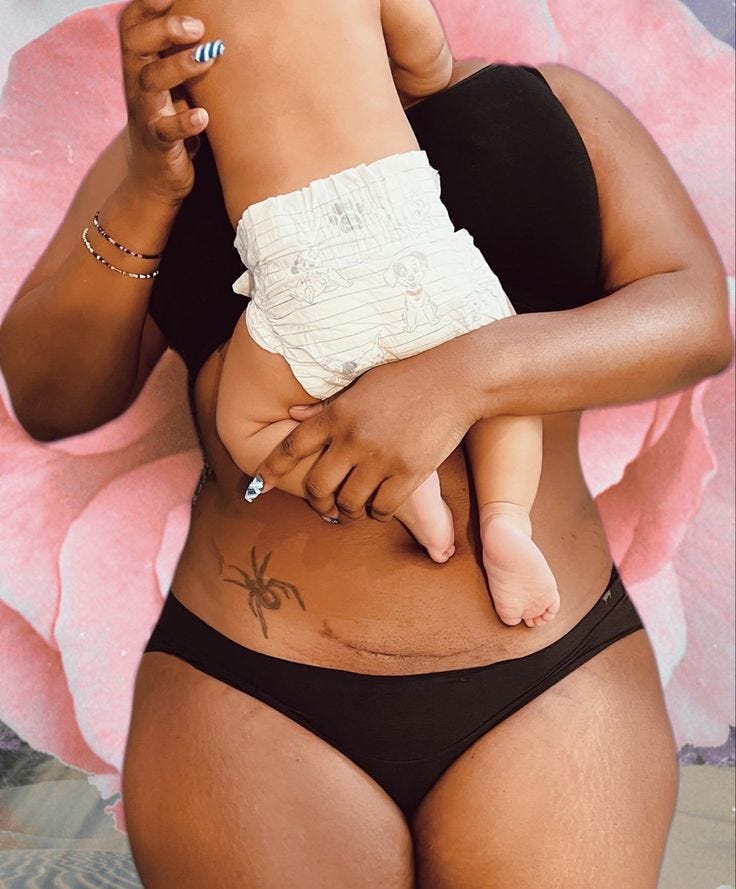
When I was pregnant with my first child, I thought I had done “all the things” to prepare. I watched The Business of Being Born, took classes, hired a Black midwife, and felt ready for an unmedicated home birth. My husband was fully supportive.
What I didn’t understand was just how powerful the system could be. After passing my due date, interventions started stacking up: “natural” induction methods, testing, pressure from my care team and extended family. Labor was long and irregular, and after a transfer to the hospital came Pitocin, monitoring, cervical checks — all the things I had hoped to avoid. Eventually, I was told, “It’s not an emergency, but a C-section is safest.” What I heard was: “You don’t have a choice.”
That first surgery was traumatic, leaving me stripped of agency and questioning my body. Sadly, my story is not unique — it’s a pattern I’ve witnessed over and over, shared by friends, echoed in family stories and confirmed by fellow birth workers.
But my story didn’t end in the OR. When I later birthed at home after my C-section — for my two HBACs — I was surrounded by people who trusted me. I labored, I pushed, I even caught my third baby myself. Those births were redemptive, healing and life-altering.
That’s why I share this: not because VBAC is right for everyone, but because too many mothers are told it isn’t an option. You deserve to know what’s possible — and to birth in freedom, whatever that looks like for you.
Wait, What Even Is a VBAC (and HBAC)?
VBAC stands for Vaginal Birth After Cesarean. HBAC means Home Birth After Cesarean. Both refer to vaginal delivery following a previous C-section.
A cesarean section (C-section) is a surgical procedure used to deliver a baby through incisions made in the mother’s abdomen and uterus. Although it’s the most common surgery performed in U.S. hospitals today, it is a major abdominal surgery with significant recovery time (while caring for a newborn).
For many mothers, choosing a VBAC is about avoiding the risks of repeat surgery (more on that below), but it’s also about something deeper: reclaiming trust in their bodies, experiencing a “natural” birth or healing from the trauma of an unwanted operation.
How Common are C-Sections, Really?
Cesarean sections were once rare, life-saving procedures. But with advances in anesthesia, antisepsis and hospital-based obstetric care (and the simultaneous, systemic erasure of Black and indigenous midwifery practices) they have become more routine.
By the 1980s and 1990s, with the rise of scheduled induction and increasing malpractice concerns, cesarean rates climbed, largely due to their predictability — and now represent nearly 33% of births in the U.S. This is more than double the 10–15% rate recommended by the World Health Organization for optimal maternal and newborn health.
And some women carry a disproportionate burden:
A California study found that Black mothers are 40% more likely to have a cesarean as compared to white mothers — even after adjusting for medical and hospital factors.
A Kaiser Permanente study reviewing nearly half a million births found that, compared with white women, Black women had a 25% higher primary C-section rate and Asian women had a 19% higher rate — even after controlling for medical and sociodemographic factors.
A large New Jersey study of nearly 1 million births also found Black women were 25% more likely to undergo C-sections than white women with similar medical histories. Among low-risk women, Black mothers were more than twice as likely to be given surgery. The gap widened when operating rooms were empty, pointing to systemic pressures and financial incentives rather than true medical need.
These patterns show how provider bias and hospital systems shape outcomes. Too often, mothers and families aren’t being heard — and are steered into surgery at higher rates.
What are the Risks and Benefits of VBAC Birth?
Benefits
Research consistently shows that for many women, VBAC is a safe and beneficial option. Benefits include:
Lower surgical risks: Fewer chances of infection, hemorrhage, blood clots or surgical injury.
Faster recovery: Shorter hospital stays, less pain postpartum and quicker return to daily life (typically).
Better outcomes in future pregnancies: Avoiding multiple C-sections reduces risks of placenta previa, placenta accreta and infertility.
Lower neonatal complications: Babies born vaginally have lower rates of breathing difficulties.
Emotional healing: Many mothers describe VBAC as redemptive, restoring agency and confidence after a traumatic first birth.
Risks
Uterine rupture: Rare, but the most serious concern. It occurs in about 0.5–1% of VBAC cases with a low-transverse incision. (Notably, your risk for uterine rupture increases each time you have a C-section delivery.)
Emergency C-section: Some VBAC labors still require surgery. But repeat planned C-sections also carry risks — including higher rates of surgical complications and neonatal breathing issues.
What’s critical is balance: the risks of VBAC are often overstated, while the risks (and recovery) of repeat C-sections are minimized. In reality, each additional C-section compounds long-term risks, and the recovery period can be intense.
What Does the Research Say?
ACOG (American College of Obstetricians and Gynecologists): Most women with one prior low-transverse C-section are candidates for VBAC. They affirm that a trial of labor after cesarean (TOLAC) is “a safe and appropriate choice for most women.”
NIH (National Institutes of Health): VBAC success rates range between 60–80%, depending on individual circumstances.
WHO (World Health Organization): C-section rates above 15% do not improve outcomes and create avoidable harm.
NEJM (New England Journal of Medicine): With repeat surgeries, risks escalate. After one C-section, placenta accreta risk is 0.3%. After two, 0.6%. After three, 2.1%. After five, it rises to 6.7%.
“Failure to Progress” — Or Failure to Support?
The most common reason given for a primary C-section is “Failure to Progress” (also called “arrest of dilation” or “arrest of descent”). According to ACOG, this accounts for roughly 35% of first-time cesareans.
Elephant in the room: words like failure and arrest when describing our laboring process speak to a system that treats birth as something to be managed and controlled, instead of honored and supported. A culture of “intervention” is baked into common practices and language.
Here’s what I mean: labor depends on a delicate hormonal balance — oxytocin (a.k.a. the “love hormone”) drives contractions, while cortisol and adrenaline (stress hormones) can slow or stall them. Many common practices in our medical system disrupt that balance long before labor is truly given a chance to unfold:
Before labor even begins: scare tactics about “big babies” or “going past due” push mothers toward early inductions that override the body’s natural timing.
During labor: continuous fetal monitoring, confinement to bed, bright lights, paperwork, interactions with multiple nurses (strangers) and frequent vaginal checks all raise stress levels, spiking cortisol and suppressing oxytocin.
The cascade of interventions: Pitocin, early epidurals or breaking the waters often lead to contractions that are more intense and harder to cope with — which can set the stage for surgery.
Cultural conditioning: movies and TV portray birth as an emergency — water breaks, chaos ensues, the doctor “saves the day.” These narratives shape expectations and fear, undermining trust in our bodies.
Too often, “failure to progress” is framed as a mother’s body failing. In truth, it’s the medical system failing to provide the conditions labor requires: privacy, safety, patience and support.
Who Should Be on My VBAC Birth Team?
Who you choose for your care team matters as much as the choice to pursue a VBAC itself. Not every provider — or every setting — is equally supportive.
OB-GYNs are the most common providers in hospital settings. Some are genuinely supportive of VBACs, while others default to repeat surgery out of habit, liability concerns or hospital policy. If you choose an OB, look for one who can clearly articulate their VBAC support, success rates and protocols.
Midwives specialize in physiological birth and family-centered care. Their model puts you at the center, not at the bottom of a hierarchy. At its best, midwifery care is patient, individualized and rooted in trust — making midwives especially well-suited to supporting VBACs. For many with pregnancies considered “low risk,” HBAC or birth center VBAC can be safe and viable options. But even within hospitals, midwives often help shift the experience from medicalized to mother-centered, improving outcomes and satisfaction.
Doulas offer continuous, trusted support that research shows makes a measurable difference. With doula care, mothers are:
39% less likely to have a C-section
15% more likely to have a spontaneous vaginal birth
10% less likely to need pain medication
31% less likely to report dissatisfaction with their birth
When you’re entering a system that often defaults to repeat surgery, a doula is not just support — they are protection, advocacy and a grounded reminder of your “why.”
Questions to ask your provider(s):
Do you support VBAC birth?
What’s your VBAC success rate?
What protocols would apply to me?
Am I a candidate for out-of-hospital VBAC?
If an emergency arises, what’s the plan?
🚩 Red Flags in Provider Conversations
“Once a C-section, always a C-section.”
Avoids or deflects when you ask about VBAC success rates.
Uses fear-based language without context or data.
Emphasizes hospital policies over your health history and preferences.
Frames VBAC as reckless rather than a safe, evidence-based option.
Speaks about “letting you” birth in a particular manner.
In Closing…
If you’ve had a C-section, your story doesn’t end there. You may still have options, if you want to explore them. You deserve care that is safe, respectful and rooted in belief in your body — not fear.
Of course, no birth outcome is ever guaranteed; but I believe that knowing our options and building a support team in line with our values enables us to birth with a sense of peace and power, come what may.
VBAC is not about proving anything or being “extra.” It’s about healing, choice and the opportunity to experience birth on your own terms — with support, safety and dignity.
Well informed and clarifying for all to know and learn. Great post wombtress 🌟🥰
Yessss, this is it! 🙌🏾 The way you named those red flags, we’ve all heard that “Once a C-section, always a C-section” line and side-eyed it together. And I love how you brought it back to us: healing, choice, and birthing from a place of peace instead of fear. This felt like sitting with a sister who reminds you of your own power. First article and already a whole sermon.