


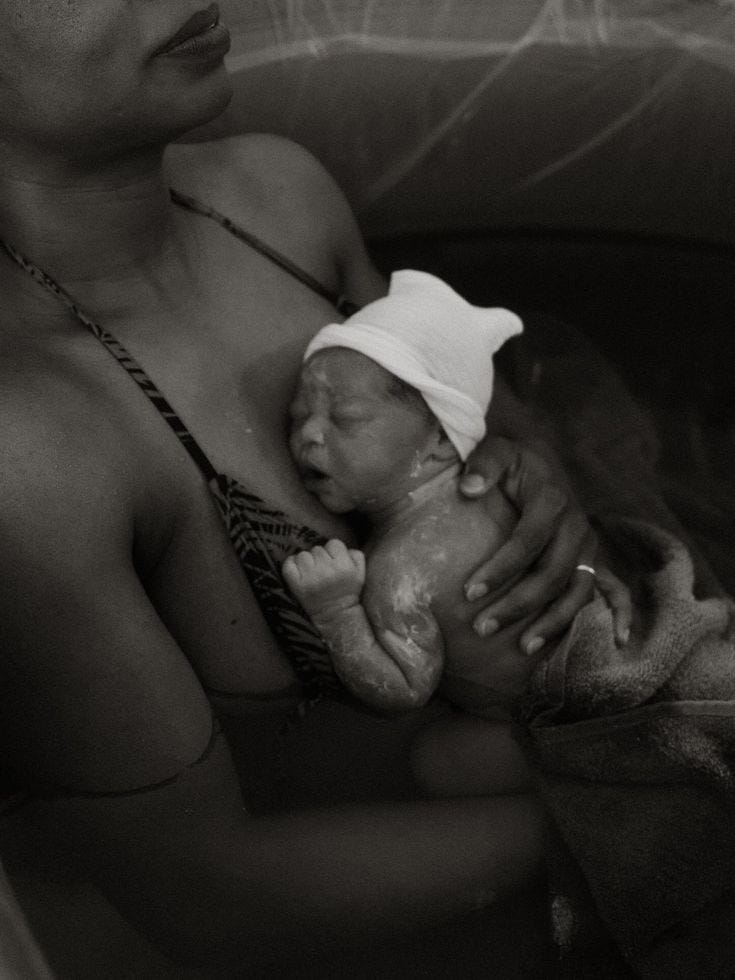
Somehow, in our modern world, birth outside the hospital has come to be seen as a “fringe” choice — for the wealthy, the white or the woo-woo. But for most of history, birth happened at home, within community. Hospitals weren’t always the norm; they became the standard only in the last century, shaped by policy, profit and perception (*cough* propaganda).
Today, in the U.S., birth is treated as a medical condition, and hospital birth is treated as the default. It’s where 98% of us give birth — and many of us never pause to even consider that other options exist. And often, providers — or even family — discourage exploring those other options.
For many, hospital birth feels like the only path because it’s the only one ever presented — not because it’s the only safe one.
So this isn’t about convincing or romanticizing. It’s simply a reminder of what’s available, and that — taking into account our medical status, of course — we have the right to birth where and how we feel safest.
And to be clear: out-of-hospital birth isn’t glamorous. It’s not (just) the dreamy videos you see on TikTok. It’s…birth. It’s messy. It’s intentional. It asks for presence, surrender, trust and partnership with your body, your baby and your team. It’s not about fear or rebellion. It’s not about you being “extra.” It’s about returning to something actually quite normal: to the quiet power that birth has always required.
So let this be a starting point, not a conclusion. If something inside you has been nudging you to explore options outside of hospital birth, this is your invitation to heed that voice. As always, I urge you to do your research, trust your intuition and choose what aligns with your needs and values.
What is Out-of-Hospital Birth?
Out-of-hospital (OOH) birth simply means birthing outside a hospital — often at home or in a freestanding birth center — with the support of trained midwives. These are planned, not emergency, births for healthy, low-risk pregnancies. (The medical and midwifery models often define ‘low-risk’ differently — something worth exploring as you do your research.) Midwives bring equipment, monitor safety throughout labor and have clear protocols for transfer if medical care becomes necessary — bridging the best of traditional and modern care.
It’s worth noting that some families choose to birth entirely without professional support — often called free birth. That’s a distinct path, one I respect but won’t speak to here. My focus is on the midwifery-led care model that centers relationship, safety and family autonomy.
Why OOH birth is core to Borne’s mission
At Borne, we believe that care should begin and end with the family — not the system. We believe in midwifery-led, family-centered maternity care where the parents’ and family’s voice is centered and decisions are made together. Not the hierarchy we’ve grown accustomed to, where insurance companies, hospital policies and profit margins often outrank people.
In a family-centered model, your care is continuous — the same midwife or small team walks with you through pregnancy, birth and postpartum. You’re not “a patient.” You’re the center of your story.

Let’s talk about safety (and myths)
When we look at the data — and the lived experiences of families — the picture becomes more nuanced than the myths suggest.
“The hospital is always safer.”
Many people assume hospital birth is automatically safer. But for healthy, low-risk mothers, research shows that planned out-of-hospital births attended by qualified midwives have similar safety outcomes — and far fewer unnecessary interventions.
“OOH birth is rare for a reason.”
Roughly 98% of U.S. births happen in hospitals, but that dominance doesn’t prove superiority, it reflects how our systems are built. Most families never hear about out-of-hospital birth as a viable option because insurance coverage, hospital partnerships and public policy overwhelmingly funnel care toward institutional settings. Even so, out-of-hospital births have steadily increased since 2020, now accounting for nearly 2% of all U.S. births — the highest rate in over 30 years.
“There’s no evidence for birth centers.”
U.S. birth-center studies show low cesarean rates and high breastfeeding initiation when care is midwifery-led and transfers are integrated.
Context matters.
The U.S. cesarean rate rose again in 2023 and our maternal mortality rate continues to climb, even as other high-income countries improve. According to the CDC, U.S. maternal deaths more than doubled between 1999 and 2019, and recent data show that rates remain highest among Black women. Despite the near-universal reliance on hospital birth — where 98% of U.S. births occur — our outcomes still lag behind our peers. We have to be honest about what that means: the crisis isn’t happening outside the system, it’s happening within it.
What changed after COVID
During and after the pandemic, families began asking deeper questions about safety, autonomy and support. Out-of-hospital birth rose nearly 20% from 2019 to 2020 — and it’s still climbing. That rise reflects more than fear of hospitals; it reflects a growing desire for personalized, respectful care that sees the family, not the chart.”
What we’re seeing is not a trend, but a remembering. A desire to be known, seen and supported through one of life’s most intimate transformations.
The benefits of home and birth-center birth
Where you give birth shapes how you give birth. The setting influences how decisions get made, which options are available, how much privacy or support you have and what happens if something changes. Every setting has pros and cons — understanding them can help you clarify what’s most important to you. Because the cons are so often emphasized, I’ll focus on the pros of OOH birth here.
Home Birth
You’re surrounded by your own comforts — your scents, your sounds, your rhythm.
You choose who’s in your space.
Your midwife focuses on physiological birth, supporting your body’s natural process.
You receive continuous care from preconception through postpartum.
Shared decision-making is the foundation, not the exception.
The care is personal, relational and centered on your family — not protocols.
And for families paying out of pocket, home birth can often be more affordable.
Birth Center Birth
A calm, home-like environment with medical readiness nearby.
Midwifery-led care that honors your body’s wisdom.
Continuity of care and individualized attention.
Shared decision-making, genuine listening and support.
Often lower cost than hospital birth, with strong data on safety and satisfaction.
Both options rely on trust — in your team, your body and the process — and both are designed to keep families at the center of care.
Challenges of hospital birth
Hospitals can absolutely save lives — and they do, every day. But they can also make it harder for families to experience birth as sacred, connected or even humane. Remember: hospitals are designed first and foremost to administer medication and perform life-saving surgeries. If you want or need access to pain relief, or if you’ve chosen a cesarean birth, a hospital is the obvious and safest place to be.
But if your goal is a physiological, unmedicated birth, you may find yourself working against the current. Hospital systems are structured for efficiency and risk management — not intimacy, continuity or autonomy. That doesn’t make them “bad,” but it does mean most are not built for the kind of birth experience many families envision.
Common challenges include:
Gaps in communication or informed consent
Rushed timelines driven by policy, not physiology
Frequent staff changes, limited privacy and inconsistent care
Higher rates of induction and surgical birth
Rigid rules about who can be present or how you can move
Implicit racial bias that still shapes care for too many families — sometimes resulting in disrespect or even criminalization
And the sheer emotional cost of feeling unseen in such a vulnerable moment
Acknowledging these realities isn’t about walking in fear. It’s about being aware. When you understand the environment you’re entering, you can plan and advocate with clarity — knowing where to lean in, where to push back and when to ask for support.
The heart of it
In short: do your research (yes, I know I say this a lot).
Consider any pre-existing conditions, as well as any experiences — from beautiful to traumatic — that may shape your feelings of safety. Get familiar with your needs, preferences and options. Talk to a midwife and/or doula who is aligned with your values. Ask questions. If your care feels misaligned, get a second (or third) opinion. You have the right to understand what birth settings are available to you — and which are available to you based on your individual health.
Home births and birth centers can be great options for low-risk pregnancies (and even VBACs, twins, breech, advanced maternal age, and other labels that the medical system considers high-risk). But if you have a serious medical condition or higher-risk factors, the hospital may be the safest choice. Knowing what’s available — and what’s realistic — helps you make confident, informed decisions.
Out-of-hospital birth isn’t for everyone, and that’s okay. What matters is that families know it exists, that it’s safe for many, and that it’s an option grounded in evidence, care and history.
We deserve systems that trust families.
We deserve care that honors physiology and harmony.
And we deserve to remember that birth — no matter where it happens — belongs to us.
Recommended Reading & Further Learning
Reclaiming Childbirth as a Rite of Passage – Rachel Reed, PhD, Midwife
Safe in a Midwife’s Hands – Linda Janet Holmes
The Doula Book – Klaus et al.
Nurturing the Family – Jacqueline Kelleher
Birth Without Fear – January Harshe
WHO: Positive Childbirth Experience Framework
References & Resource List
U.S. Birth Statistics & Trends
Centers for Disease Control and Prevention (CDC).
Trends in Out-of-Hospital Births in the United States, 1990–2022.
National Vital Statistics Reports, Vol. 73, No. 2. (February 2024).
CDC National Center for Health Statistics.
Births: Final Data for 2023 (preliminary release, NVSS).
Maternal Mortality & Morbidity
CDC National Center for Health Statistics.
Maternal Mortality Rates in the United States, 2021.
NIH / JAMA.
Tikkanen, R. et al. “Trends in State-Level Maternal Mortality by Race and Ethnicity, 1999–2019.” JAMA, 2023.
Commonwealth Fund.
Tackling the U.S. Maternal Health Crisis. (2022).
Out-of-Hospital & Midwifery Outcomes
Cheyney, M. et al. “Outcomes of Planned Home Birth with Midwife: A Prospective Cohort Study.” Birth, 2014.
Stapleton, S.R., Osborn, C., Illuzzi, J. “Outcomes of Care in Birth Centers: The National Birth Center Study II.” Journal of Midwifery & Women’s Health, 2013.
Scarf, V. et al. “Planned Place of Birth and Maternal and Perinatal Outcomes in High-Income Countries.” Cochrane Database of Systematic Reviews, 2018.
International Confederation of Midwives (ICM).
Global Standards for Midwifery Education and Regulation. (2021).
International Childbirth Education Association (ICEA).
Family-Centered Maternity Care Position Paper. (2020).
Systems, Access & Insurance Barriers
Time Magazine.
“Home Births Became More Popular During the Pandemic. But Many Insurers Still Don’t Cover Them.” (2022).
Aetna Clinical Policy Bulletin 0329.
“Planned Home Birth.” (2023).
ValuePenguin.
“Does Health Insurance Cover Home Birth?” (2023).
BirthPlace Lab (University of British Columbia).
Giving Voice to Mothers – U.S. Survey Report. (2020).
Comparative & Global Context
World Health Organization (WHO).
WHO Recommendations: Intrapartum Care for a Positive Childbirth Experience. (2018).
OECD Health Statistics.
Maternal Mortality and Cesarean Rates, 2023 Update.