


Intro & On Why Postpartum Matters
(~00:00)
Lindsey:
We’re here tonight to talk about postpartum. And because I’m a bit of a nerd, I’ll start with some grounding statistics.
Did you know the U.S. is one of only seven countries in the world with no guaranteed paid parental leave?
One in four mothers here return to work within just two weeks of giving birth — while the World Health Organization recommends a minimum of 18 weeks.
Nearly one in five mothers experience postpartum depression.
Thousands are readmitted to the hospital within the first month.
The postpartum period is critical, yet often ignored. So many mothers suffer in silence without the words to describe what they’re going through. That silence ripples outward — this isn’t just a family issue or a women’s issue, it’s a societal issue. That’s why we’re here: to talk about healing, about navigating this season, and about breaking that silence.
I’m Lindsey, founder of Borne and CRWNMAG, and I’m joined by Eve — my doula, my sister in this work, and now my partner in building spaces like this. Together, we want to make quality insights more accessible because how we heal after birth shapes everything — our health, our confidence, our relationships, even our societies. And since there are no formal structures in place to support us, we have to create them ourselves.
Eve: I think one thing that stands out is how “postpartum” has almost become synonymous with depression. Yes, one in five women do experience postpartum depression — but five in five think postpartum means depression. It doesn’t. Postpartum simply means “after birth.”
After birth, we should be healing. We should be bonding, supported, empowered, surrounded by love. Yet too often, it’s sad, it’s hard, and relationships can suffer. I know my own first postpartum experience changed my life and my relationship forever. That’s a common story.
Even if it’s just in our little corner, we have to change the narrative. We have to celebrate mothers, recognize when something’s off, and show up for one another. My hope, always as a doula, is that I can light someone’s candle with mine — and they light someone else’s, until the whole path is illuminated.
On Processing Trauma
(~00:15)
Lindsey:
Let’s start with the big one. What does processing a birth or postpartum trauma with a doula look like? And how does somebody know if they’re ready for this, or when they’ll know they’re ready?
Eve:
For me, I knew I was ready when I felt like there was just too much pain sitting on my chest. I couldn’t carry it alone anymore. I think that’s often the sign — when it feels like you’re holding it all by yourself and it’s weighing you down.
Processing trauma looks like a doula holding space for your story without judgment. It means being able to tell what happened, to name it, and have someone witness you in that. And it also means being reminded that what happened wasn’t your fault.
Sometimes processing can be ritual-based. It might look like lighting a candle for yourself every night. It might be whispering your story out loud, writing it down, crying, praying. The body holds on to what the mind is trying to forget, so you need practices that let that energy move.
I use gardening a lot when I talk about birth and postpartum because it’s such a good metaphor. Planting seeds in the dark, not knowing what’s happening under the soil, and then one day something small breaks through. Processing trauma can feel the same way — it looks quiet on the outside, but deep work is happening inside.
Even the most beautiful births can carry moments that feel traumatic. That’s why I love herbal baths for postpartum mothers. They’re not just pretty water with flowers floating around — they’re a chance to sit, reflect, and name your experience. To say what felt amazing, what didn’t, what felt out of your control. That kind of reflection is healing.
And sometimes your best friend or your mom can’t meet you in that space. That’s why doulas, or therapists trained in perinatal work, are so important. They can hold that container for you in a way others can’t.
On Planning for Postpartum
(~00:40)
Lindsey:
For the person who says, “I struggled to recover before. What should my postpartum plan include this time?” What does planning for a better recovery look like?
Eve:
Planning for postpartum recovery means creating an environment where you are drenched in gentleness. However many days you can set aside — 21, 30, 40, three months — treat those days as sacred.
Healing isn’t extra. It’s not doing the most. It’s necessary. We spend nearly 300 days growing a human being. Can we not take 40 days to call holy for ourselves?
Your plan should include ritual. Herbs. Baths. Time to sit with your baby and just be. Space for affirmations, journaling, or prayer. Think about what you need in the room with you — maybe it’s your postpartum tub, maybe it’s your favorite tea, maybe it’s the playlist that grounds you.
Food is a huge part of planning. I love meal trains — getting friends, family, and community members to sign up to bring food. It’s not just about convenience, it’s about nourishment. Soups, stews, bone broth, things you can heat easily. If you don’t want guests, that’s okay. Tell people: “We’re not inviting visitors right now, but what you can do to support us is bring food.” Boundaries protect healing.
If you can’t hire a postpartum doula, designate someone you trust to fill that role. They can boil your herbs, prep your snacks, reset the house at the end of the day. Sometimes that’s a partner, sometimes it’s a friend, sometimes it’s a cousin who loves you enough to follow directions.
And then there’s money. Instead of a baby shower that looks like a wedding, what about a mama shower? What if people pooled resources for diapers, groceries, or $250 toward a postpartum doula? What if instead of twenty onesies, you had meals delivered for three weeks?
It comes down to this: you deserve to rest. You deserve support. Boundaries and planning make that possible. Without them, you end up entertaining guests when you should be sleeping. With them, you get to cocoon. And in that cocoon, your healing unfolds.
On Support Systems
An Excerpt from our forthcoming Hospital Birth Guide:
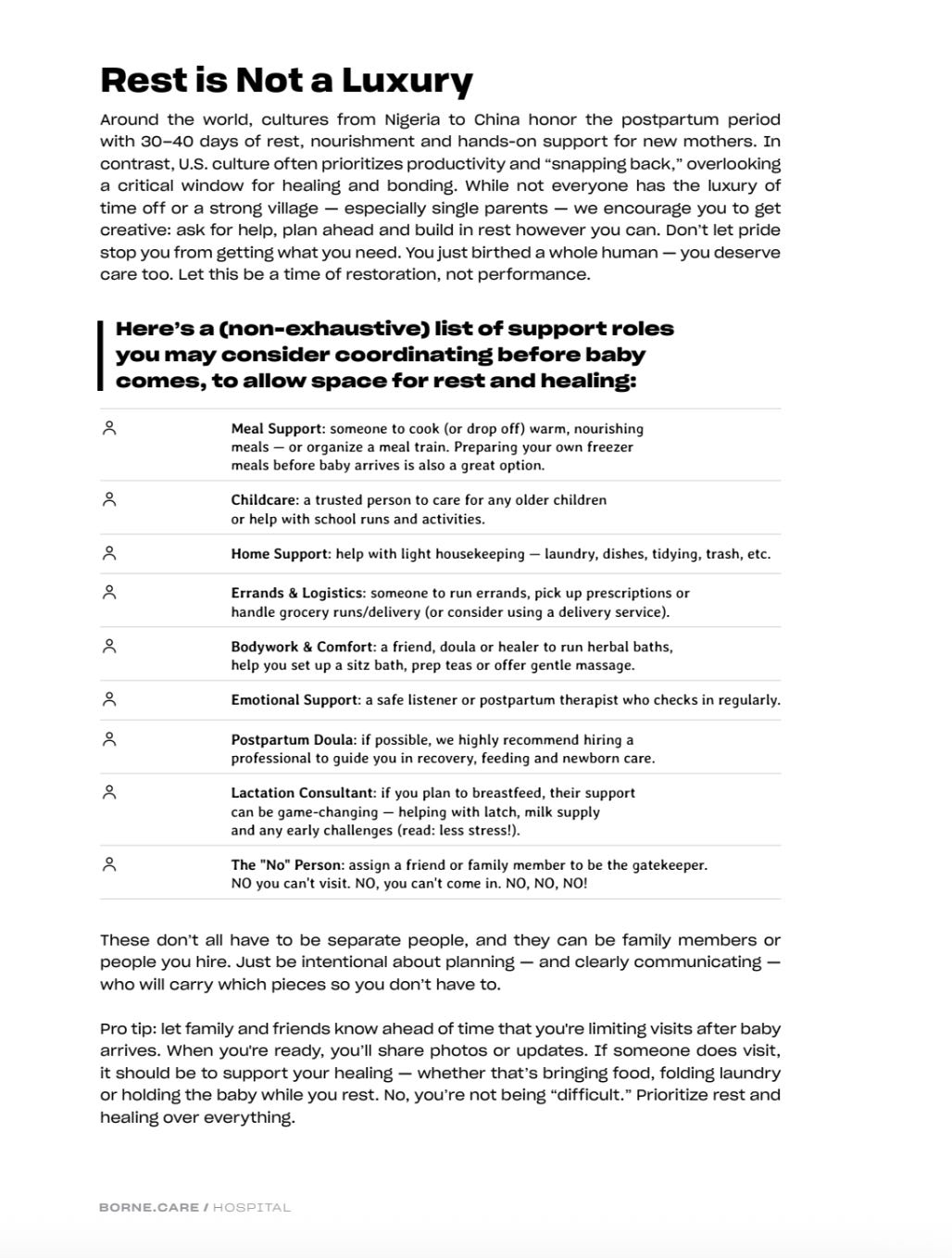
Lightning Round
(~01:05)
One postpartum item that actually matters
Lindsey:
The milk catcher — specifically the Elvie Curve. Every drop matters.
Eve:
Padsicles. They make a huge difference in those first days of healing.
One snack every new mom should keep on hand
Lindsey:
Coconut water, nuts and fruit, and bone broth — things that hydrate and nourish at the same time.
Eve:
Pistachios, trail mix. Quick protein and easy to eat with one hand.
One thing visitors should always do before holding the baby
Lindsey:
Use a Montessori mat — a topponcino — so the baby feels held in something familiar and not just jostled from arm to arm.
Eve:
Use a scent cloth. It helps keep the baby calm and connected.
One tip for easing into postpartum sex
Lindsey:
Keep it lighthearted and pressure-free. Start slow, focus on intimacy over performance.
Eve:
Go playful. Maybe oral, maybe toys — and don’t skip lube. Breastfeeding makes things dry, and there’s nothing wrong with using support. Coconut oil is a great option.
One myth about postpartum you’d love to bust
Lindsey:
The concept of the “snapback.” You don’t bounce back — you change, and that’s a beatiful thing.
Eve:
That postpartum equals depression. It doesn’t. Postpartum simply means “after birth.”


